

How to Outsource Product Prototyping Right
A prototype that looks impressive in a render can still fail the moment it meets real materials, real tolerances, and real deadlines. That is why knowing how to outsource product prototyping is less about finding a vendor with a machine list and more about choosing a partner that can turn an idea into a testable, buildable object without losing speed, intent, or quality.
For brands, architects, product teams, and agencies, outsourcing prototyping can remove a huge operational burden. It can also create new problems if the handoff is vague, the supplier is process-limited, or the prototype is built in a way that does not reflect the final use case. The best outsourced prototype is not just fast. It answers the right questions before you commit to production, launch, installation, or stakeholder approval.
How to outsource product prototyping with a clear brief
Most prototyping delays start before fabrication begins. A partner cannot quote accurately, choose the right process, or flag technical risks if the brief only says something like, “we need a sample soon.” Speed comes from clarity.
Start by defining what the prototype needs to prove. Sometimes you need a visual model for investor review or client approval. Other times you need a functional part that must survive assembly, load, heat, or repeated handling. Those are very different jobs, and they should not be prototyped the same way.
A strong brief usually includes intended use, target dimensions, preferred materials if known, finish expectations, quantity, timeline, and any critical tolerances. If you have drawings, CAD files, reference photos, or an existing part for reverse engineering, include them early. If you do not, say that clearly too. A capable prototyping partner can often help shape the development path, but only if they understand where the ambiguity is.
This is also where many teams make a costly mistake. They ask for a final-looking prototype before resolving the core engineering questions. That can burn budget on cosmetic refinements too early. In many cases, it is smarter to phase the work: prove form first, then fit, then function, then finish.
Choose a partner, not just a process
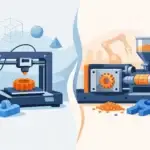
When people think about outsourcing, they often compare suppliers by equipment. One shop has industrial 3D printing. Another offers CNC machining. Another does casting or fiberglass. The problem is that prototyping decisions are rarely process-pure.
A useful prototype may combine multiple methods. You might need a CNC-machined section for accuracy, a 3D printed enclosure for iteration speed, and hand finishing for presentation quality. If your vendor only offers one lane, they are likely to force the design into that lane whether or not it serves the project.
That is why partner selection matters more than a low unit price on a single technique. Look for a team that can evaluate the prototype based on performance, visual intent, and next-step manufacturability. The right partner should be able to explain why one method makes sense now and why another may be better later.
In practice, integrated capability matters. If one team can model, print, machine, cast, finish, and refine the part in-house, there are fewer handoff errors and fewer schedule surprises. That matters even more for premium projects, display-ready samples, branded environments, and custom components where the prototype must communicate both technical feasibility and visual impact.
What to ask before you outsource
A good outsourcing decision usually comes down to a few direct questions. Can the partner prototype for your actual application, not just create a generic sample? Can they work from incomplete information and still move the project forward intelligently? Can they advise on materials and tolerances instead of waiting for perfect instructions?
You should also ask how revisions are handled. Prototyping is iterative by nature. If every change creates friction, delays, or confusion over ownership, the process will stall. A serious fabrication partner should have a defined review flow with approval checkpoints, revision tracking, and realistic communication around what changes are minor and what changes reset production.
Lead time transparency matters too. Fast turnaround is valuable, but not if it depends on assumptions that collapse later. Ask what is included in the quoted timeline: file prep, design cleanup, fabrication, finishing, testing, and delivery. A two-day print is not the same as a two-day prototype.
How to outsource product prototyping without sacrificing quality
Quality control in prototyping is different from quality control in full production. You are not just checking whether a part matches a drawing. You are checking whether the prototype answers the decision in front of you.
If the goal is fit verification, dimensional accuracy comes first. If the goal is a sales sample, surface finish and visual realism may matter more. If the prototype is meant for field testing, the material choice and structural performance should lead the conversation. The point is simple: quality is contextual.
This is where experienced partners create real value. They can tell you when a beautiful cosmetic model will give false confidence, or when an expensive engineering-grade prototype is unnecessary for an early-stage review. The trade-off is rarely between good and bad. It is usually between different kinds of usefulness.
It also helps to separate prototype quality from final production quality. Some clients expect a first prototype to look exactly like the finished manufactured item. Sometimes that is possible. Often it is not the smartest use of time or budget. A prototype should be accurate enough to validate the right variables at the right stage.
Budget for learning, not just for making
Outsourced prototyping is often treated like a purchasing exercise. Send files, get a part, approve the invoice. That mindset misses the real value. A prototype is a learning tool.
The cheapest quote can become the most expensive route if it produces a part that cannot be tested properly or has to be remade because no one challenged the design assumptions. On the other hand, a slightly higher upfront cost can save weeks if the partner catches manufacturability issues early, suggests a better material, or builds the prototype in a way that supports the next production step.
This is especially relevant for custom displays, architectural elements, branded objects, specialty components, and investor-facing product samples. In those cases, the prototype is not just proof of concept. It may influence approvals, budget release, client confidence, or public presentation.
For projects in the UAE, Saudi Arabia, Qatar, or Oman, outsourcing to a partner with both design interpretation and fabrication depth can also reduce the delays that come from coordinating separate modelers, machine shops, finishers, and installers across a compressed schedule.
Watch for the hidden failure points
Most outsourced prototype problems are predictable. The file is not production-ready. The material selected for speed behaves differently than the final one. The partner builds exactly what was sent, even though the design had obvious weak points. Finishing is treated as an afterthought, so the sample tests well but presents poorly.
Another common issue is overconfidence in digital models. CAD can be precise while the concept is still unresolved. Thin walls, unsupported spans, awkward assembly points, and unrealistic tolerances often reveal themselves only when someone with fabrication experience reviews the part as a physical object rather than a screen-based design.
That is why communication should stay active after kickoff. The best outsourcing relationships include technical feedback, not just order updates. If your partner never questions anything, that is not always a sign of efficiency. Sometimes it is a sign they are fabricating blind.
A smarter outsourcing workflow
The strongest outsourcing workflows are collaborative but disciplined. You begin with intent, constraints, and reference material. The prototyping partner then translates that into a feasible build path, often recommending the fastest way to answer the most important question first. After that comes fabrication, review, revision if needed, and then either a refined prototype or a transition into production.
This process sounds straightforward, but execution is where projects succeed or fail. Strong teams bring engineering judgment, material fluency, and finishing capability into the same conversation. That is what turns a prototype from a simple sample into a decision-making tool.
A studio like 3Distica is built around that kind of integrated execution. When design development, rapid prototyping, machining, fabrication, finishing, and final presentation can happen under one roof, the prototype stays aligned with the original concept while moving faster toward something real.
If you are deciding how to outsource product prototyping, think beyond who can make the part. Choose the team that can reduce uncertainty, protect the design intent, and help you make the next decision with confidence. That is when prototyping starts doing what it is supposed to do – not just producing an object, but moving the whole project forward.