
SLA vs SLS Printing: Which Fits Your Part?
When a prototype looks perfect on screen but fails in the real world, the printing process is often the reason. The SLA vs SLS printing decision is not just about material type or machine preference. It shapes surface quality, tolerances, lead time, post-processing, and whether the final part is best suited for presentation, testing, or production use.
For architects, product teams, agencies, and manufacturers, that choice matters early. A display model, a cosmetic housing, a mechanical bracket, and a short-run functional part all ask for different strengths. The right process can speed up approvals, reduce finishing work, and produce a part that behaves the way the project demands.
SLA vs SLS printing at a glance
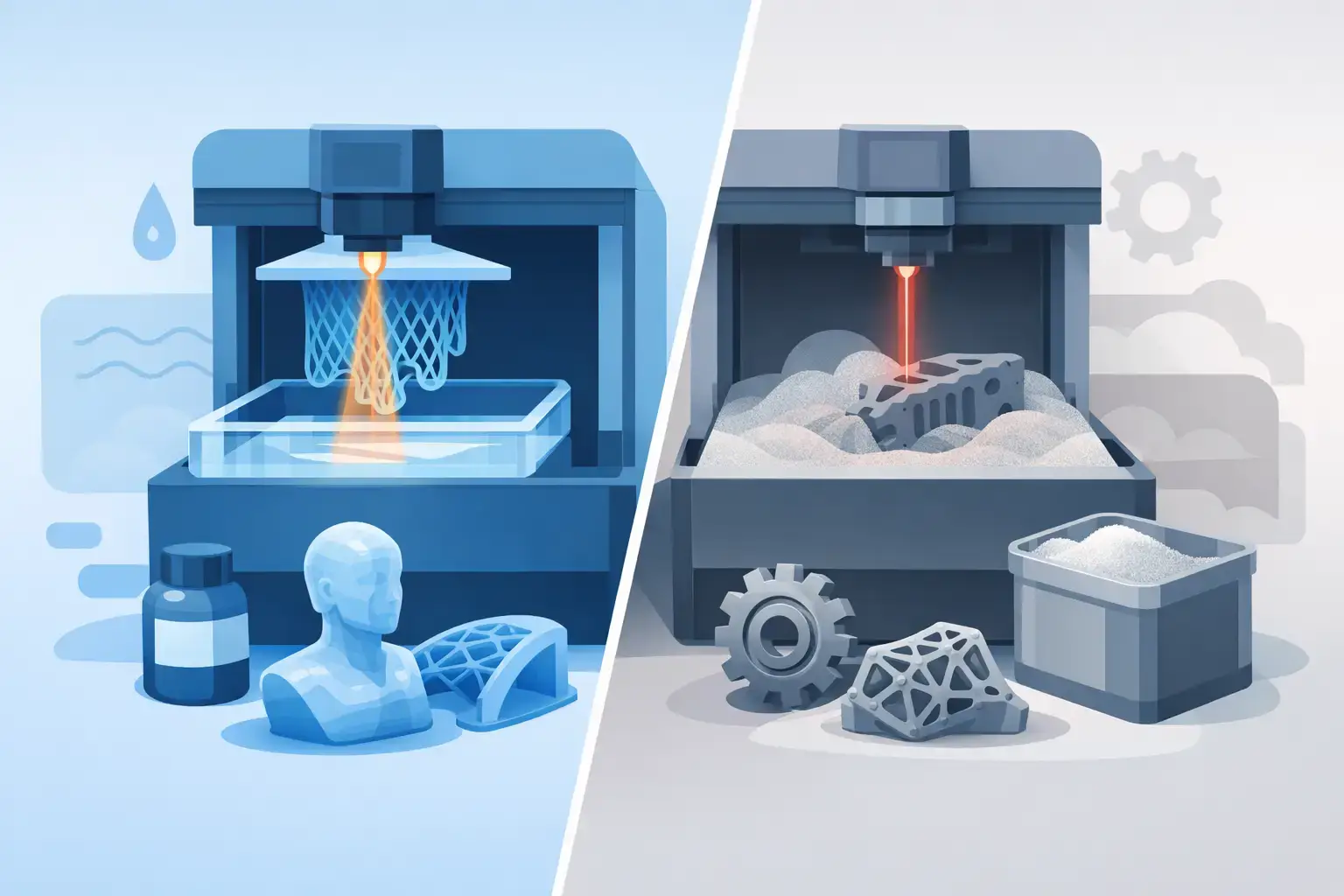
SLA, or stereolithography, uses a laser to cure liquid resin layer by layer. It is known for sharp detail, smooth surfaces, and excellent visual presentation. If your priority is fine features, clean edges, or a premium appearance before painting and finishing, SLA is often the first process worth considering.
SLS, or selective laser sintering, uses a laser to fuse powdered nylon into solid parts. It is typically chosen for strength, design freedom, and practical performance. Because the surrounding powder supports the part during the build, SLS can produce complex geometries without the same support strategy required in SLA.
That difference affects more than the machine setup. SLA tends to favor visual fidelity and controlled aesthetics. SLS tends to favor durability, utility, and parts that need to work hard rather than simply look refined.
Surface finish and visual quality
If appearance leads the brief, SLA usually has the advantage. It produces parts with a smoother, more polished surface straight off the machine, especially compared with the slightly grainier texture common in SLS nylon. This makes SLA a strong fit for presentation prototypes, architectural elements, display components, and master patterns for molding or casting.
Fine lettering, embossed branding, miniature details, and subtle contours also tend to read more clearly in SLA. That matters when the part is client-facing or camera-facing, or when the prototype needs to communicate design intent with very little explanation.
SLS can still look excellent, but it usually needs a different expectation. The finish is more technical than cosmetic unless secondary finishing is planned. For some industrial parts, that is not a drawback at all. In fact, the natural matte texture of SLS can be perfectly appropriate for housings, fixtures, internal components, and functional assemblies.
Strength, flexibility, and real-world performance
This is where the SLA vs SLS printing comparison becomes more dependent on application. Standard SLA resins can be rigid and precise, but many are also more brittle than SLS nylon. That means they may perform well for fit checks, display pieces, and concept validation, yet struggle under repeated impact, flexing, or heavy mechanical load.
SLS parts, typically made in nylon, are generally tougher and more forgiving. They can handle snap fits, clips, repeated handling, and practical testing more reliably. For engineering prototypes, brackets, enclosures, ducting, jigs, and low-volume functional components, SLS often brings more confidence.
There is nuance here. Resin options for SLA have improved, and specialized materials can simulate toughness, heat resistance, or flexibility. But if the part will be used, handled, installed, or stressed in a way that resembles actual service conditions, SLS usually starts from a stronger position.
Geometry, complexity, and design freedom
SLS is often the better answer for complex internal geometry. Since the powder bed supports the part during printing, designers can create interlocking features, internal channels, lattice structures, and nested assemblies with fewer support-related limitations. That opens up real freedom for functional design and batch production.
SLA requires support structures, and while those can be managed carefully, they still influence orientation, surface marks, and post-processing time. For highly visible surfaces or delicate features, support placement becomes a planning issue rather than a minor detail.
This does not make SLA unsuitable for complex parts. It simply means the design has to be evaluated through a different lens. If geometry is intricate but the priority is still surface precision, SLA may remain the better path. If geometry is intricate and the priority is performance or efficiency, SLS often wins.
Accuracy and tolerances
Both processes can deliver strong dimensional accuracy when handled properly, but they excel in different ways. SLA is often preferred for small, detailed components where edge definition and crisp visual geometry matter. Dental models, concept miniatures, cosmetic prototypes, and finely featured presentation parts benefit from that precision.
SLS performs well for functional tolerances and larger assemblies, especially when the goal is practical fit and repeatability across durable nylon parts. It is commonly used for working components that need to slot into a broader system without being treated as delicate objects.
The best choice depends on what accuracy means for your project. If you need visual sharpness and smooth form, SLA can feel more exact. If you need durable, dependable fit across a mechanical use case, SLS may deliver the more useful result.
Post-processing, finishing, and workflow impact
SLA parts require washing and post-curing after printing, along with support removal. Depending on geometry, that can be straightforward or fairly involved. The upside is that the parts often start from a finish-friendly baseline, which is valuable if painting, coating, or display presentation is part of the brief.
SLS parts come out of a powder bed and need depowdering, but they typically avoid the support-removal stage that comes with SLA. This can make them efficient for batches of functional parts. If the goal is to move from print to test quickly, SLS can offer a practical advantage.
Finishing also changes the equation. In a full production environment, printed parts are rarely judged only as raw outputs. Sanding, priming, painting, dyeing, coating, machining, and assembly all influence the final result. A studio with in-house fabrication and finishing capabilities can push either process much further than a machine-only supplier.
Cost and production logic
Price depends on part size, volume, material, machine time, and finishing requirements, so there is no universal winner. Small, highly detailed visual parts can be cost-effective in SLA. Functional nylon parts, especially when multiple items are nested in a single build, can favor SLS.
The more useful question is not which process is cheaper in general, but which process is cheaper for the outcome you actually need. A lower-cost print that breaks, photographs poorly, or demands extensive rework is rarely the better value. Good production planning looks at the total path from concept to finished part.
For clients managing retail displays, branded activations, product launches, architectural presentations, or pilot production, that bigger view matters. The right print process should reduce friction downstream, not create it.
When to choose SLA vs SLS printing
Choose SLA when visual quality is central to the project. It is often the right fit for presentation models, design validation, display-ready prototypes, master patterns, and parts where refined detail carries decision-making weight.
Choose SLS when the part needs to perform. It is a strong option for durable prototypes, mechanical testing, end-use nylon parts, low-volume production, and complex assemblies that benefit from support-free geometry.
There are also mixed-process projects where both technologies earn a place. A product team may use SLA for stakeholder presentations and SLS for mechanical validation. An architectural or experiential build may use SLA for highly detailed feature elements and SLS for hidden structural components. The smartest production strategy is often not process loyalty, but process alignment.
The better question is what the part needs to do
The SLA vs SLS printing choice is really a conversation about intent. Does the part need to persuade, perform, or do both? Will it be painted, handled, installed, tested, or replicated? Is speed more important than finish, or is finish the whole point?
At 3Distica, those decisions are usually made in the context of a larger build, not in isolation. A prototype may lead to molding, casting, CNC machining, surface finishing, or installation. That is why process selection works best when it is tied to the full production path rather than treated as a standalone purchase.
If you are weighing SLA against SLS, start with the demands of the finished part, not the label on the machine. The right process should make the next stage easier, the final result stronger, and the original idea more convincing once it becomes physical.