
3D Printing vs Injection Molding
A prototype that looks perfect on screen can become very expensive the moment it hits production. That is where the real 3d printing vs injection molding decision starts – not with theory, but with quantity, lead time, finish requirements, and how much design flexibility the project actually needs.
For product teams, architects, brand producers, and manufacturers, this choice affects far more than unit cost. It changes how fast you can test ideas, how much risk you carry before launch, and whether your parts arrive as rough concepts or market-ready components. The best process is rarely the one with the strongest headline. It is the one that fits the stage, scale, and performance demands of the job.
3D printing vs injection molding: the core difference
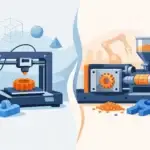
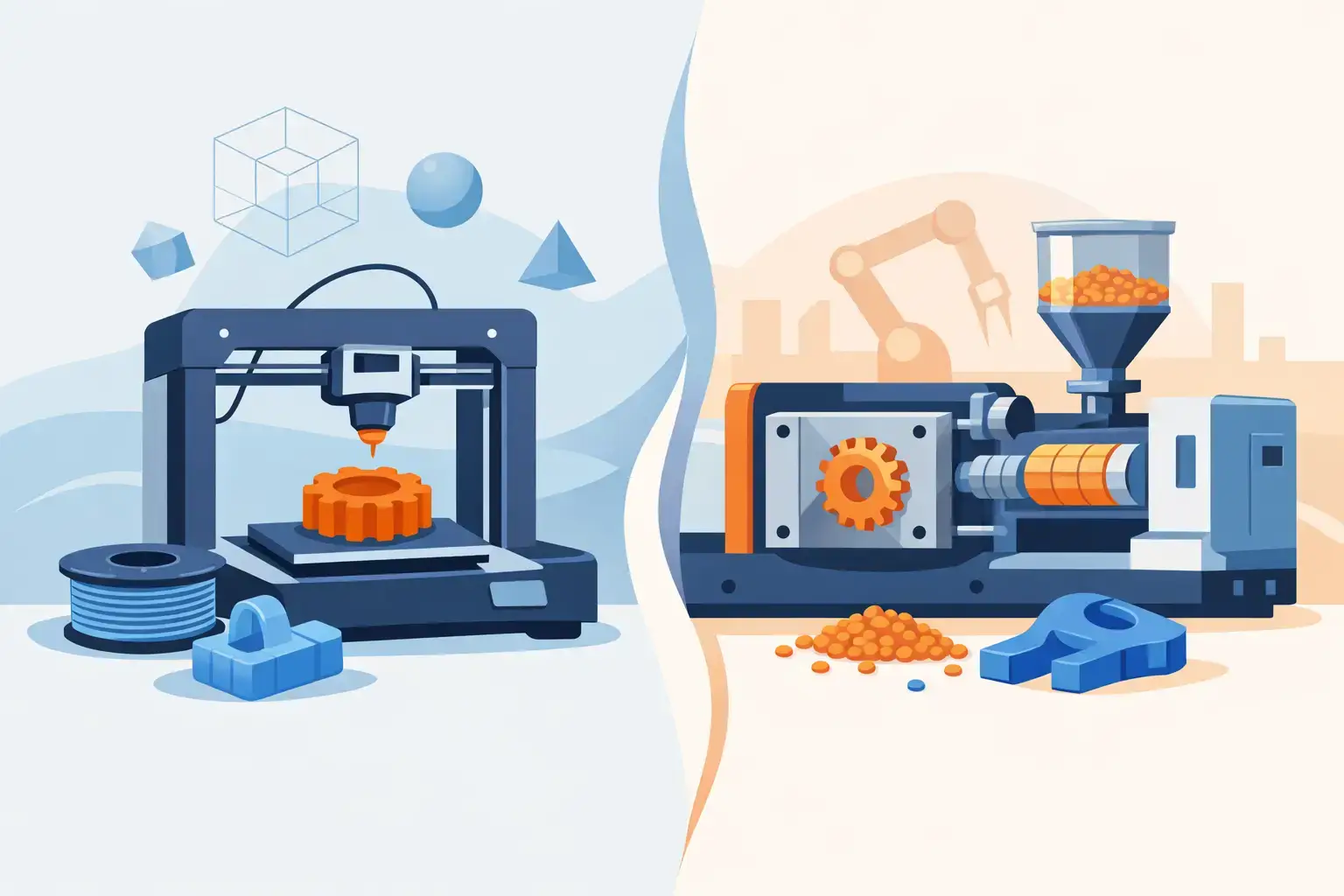
At a basic level, 3D printing builds parts layer by layer from a digital file. Injection molding uses a machined mold tool to produce parts by forcing material into a cavity under pressure. One is highly flexible with low startup barriers. The other is built for repeatability and volume.
That difference shapes everything else. With 3D printing, you can move from CAD to physical part quickly, often without tooling. You can revise geometry, print again, and keep iterating. With injection molding, the upfront commitment is much higher because the mold has to be designed, engineered, machined, and tested before production begins. Once that tool is right, though, the process becomes extremely efficient for larger runs.
This is why the comparison is not really about which method is better. It is about when each method creates the strongest production path.
When 3D printing makes more sense
3D printing is strongest when speed and adaptability matter more than volume efficiency. If you are developing a new product, validating a fit, testing an assembly, or producing a limited run, it usually gives you more control with less friction.
That is especially true when the design is still moving. If your team expects multiple revisions, investing in injection tooling too early can lock you into cost before the part is fully resolved. A printed prototype, by contrast, lets you test dimensions, ergonomics, tolerances, and visual presentation before committing to a mold.
Complex geometry is another major advantage. Internal channels, lattice structures, custom contours, and one-off features are often easier to produce with additive manufacturing than with a mold-based process. For industries handling customized components, architectural models, display elements, jigs, fixtures, or presentation pieces, this flexibility can be more valuable than a low per-part cost.
There is also a practical business case. If you only need tens or a few hundred pieces, molding may never recover its tooling investment. In that range, 3D printing often wins simply because it avoids the startup cost.
Where 3D printing has limits
The trade-off is scale. As quantities rise, print time and labor can make additive production less competitive. Surface finish can also vary depending on the technology used. Some printed parts need sanding, filling, coating, painting, or other finishing steps to reach a presentation-grade result.
Material selection is broad, but it is not always equivalent to injection-molded plastics in long-term mechanical performance. For functional end-use parts, that distinction matters. The right print process can produce excellent results, but material and application must be matched carefully.
When injection molding is the better move
Injection molding is built for repeatable production. If the design is stable and the target quantity is high, few processes can match its efficiency. Once the mold is complete, each additional part is relatively fast and cost-effective.
This matters for consumer products, housings, packaged components, branded goods, and industrial parts where consistency is non-negotiable. Molded parts can deliver strong repeatability across large batches, with reliable dimensions, consistent surface finish, and production-ready materials.
For procurement and operations teams, that predictability is a major advantage. Unit economics become easier to model. Lead times become more stable after tooling approval. Quality control becomes easier to manage because the process is designed for repetition.
Injection molding also supports a wide range of production plastics with known performance characteristics. If your part needs heat resistance, impact strength, flexibility, or compliance with a specific use case, molding often provides more familiar mass-production pathways.
Where injection molding becomes difficult
The challenge is the upfront commitment. Tooling can be expensive, and the timeline is longer than printing. Any design changes after the mold is cut can be costly, and in some cases they require tool modifications or complete replacement.
That makes molding a poor first move for uncertain designs. If your product is still evolving, the mold can become the most expensive version of a guess.
Cost is not just about price per part
This is where many comparisons go wrong. People often hear that 3D printing is expensive per part and injection molding is cheap per part, which is true only in a narrow sense.
A better question is total project cost at a specific stage. If you need 20 parts by next week and the design is still under review, printing may be dramatically cheaper overall because there is no tooling, no long setup phase, and no cost tied to early mistakes. If you need 20,000 parts over the next quarter and the geometry is finalized, injection molding will likely outperform it on economics.
There is a crossover point, but it is not universal. It depends on part size, complexity, material, finish, tolerance, and how many versions you expect to test before approval. A simple enclosure and a highly detailed custom component will reach that crossover at very different volumes.
For many teams, the smartest path is phased. Print first, mold later. That approach reduces risk because design issues get exposed before tooling money is committed.
Speed depends on what kind of speed you need
If the goal is the fastest possible first article, 3D printing usually wins. You can move from file to part quickly, which is critical when presentations, approvals, investor reviews, fit tests, or client sign-offs are on the line.
But if the goal is producing thousands of identical parts once the design is approved, injection molding is faster at scale. The setup takes longer, yet the production rate after that point is far higher.
So speed has two meanings. There is speed to first part, and speed to full production. The right process depends on which one matters most to the project.
Quality, finish, and presentation
For visual projects, this question is just as important as cost. A raw printed part and a finished printed part are not the same product. With the right post-processing, 3D printing can achieve impressive cosmetic quality, especially for display models, branded environments, custom installations, and premium prototypes. That finishing stage is where fabrication expertise matters.
Injection molding, however, starts with an advantage in consistency. If the tool is engineered correctly, each part can come out with a highly uniform finish. That is valuable for retail-facing products or production runs where aesthetic variation is unacceptable.
Still, quality should be judged by the final deliverable, not only the base process. In many commercial and creative applications, a printed component that is properly finished, assembled, and coated can meet the visual standard just as effectively as a molded one.
The smartest decision is often a hybrid one
In real-world manufacturing, this is rarely an either-or debate. A strong production strategy often combines both methods.
Teams may use 3D printing for concept models, proof-of-fit parts, sales samples, and pilot runs, then shift to injection molding once demand is validated. They may also print jigs, fixtures, assembly aids, or mold masters to support a larger manufacturing workflow. For custom activations, event builds, architectural elements, or mixed-volume product programs, hybrid production is often the most efficient route.
That is where an integrated fabrication partner creates real value. When design, prototyping, machining, molding, finishing, and production planning are aligned under one roof, process selection becomes more strategic and less reactive. Instead of forcing every project into the same method, the method is chosen to fit the outcome.
How to choose between them
If your project is low-volume, design-sensitive, highly customized, or time-critical, 3D printing is usually the stronger option. If your part is finalized, volume is high, and consistency across production runs matters most, injection molding is usually the better investment.
The gray area sits in the middle, where many commercial projects live. That is why the right question is not just 3d printing vs injection molding. It is what stage your product is in, what level of risk you can afford, and what kind of result the market actually needs.
The most efficient manufacturing decision is the one that respects both ambition and reality. Build fast when you need to learn. Tool up when you are ready to scale. If you choose the process at the right moment, the part has a much better chance of succeeding long before it reaches the production line.