

Why Use One Fabrication Partner?
A project starts to slip the moment the handoffs start multiplying. The designer sends files to one shop, the prototype goes to another, finishing happens somewhere else, and installation becomes its own separate coordination problem. If you are asking why use one fabrication partner, the short answer is control. The longer answer is that control affects everything that matters – speed, quality, cost predictability, accountability, and the final visual result.
For architects, agencies, brand teams, developers, and manufacturers, that difference is not theoretical. It shows up in missed tolerances, revised drawings, color inconsistencies, shipping delays, and expensive rework. When one capable partner manages design support, prototyping, fabrication, finishing, and final delivery, the entire process becomes easier to direct and harder to derail.
Why use one fabrication partner for complex projects
Complex projects rarely fail because one idea was bad. They fail because the execution chain gets fragmented. A branded environment, public installation, architectural model, retail display, sculptural feature, or custom product often moves through multiple disciplines before it is complete. Every transition introduces risk.
When the same fabrication partner handles the project from early development through production, design intent stays intact. The team that reviews the concept is also thinking about material behavior, structural requirements, machining constraints, assembly logic, finishing standards, and installation conditions. That changes the quality of decisions made at the beginning, when changes are still efficient and affordable.
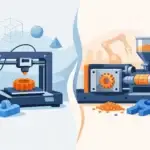
A multi-vendor workflow can still work, especially for highly specialized jobs or very large production runs that require niche capacity. But it usually demands more oversight from the client side. Someone has to translate between suppliers, compare conflicting advice, manage timelines, and absorb the impact when one vendor blames another. If your internal team does not want to become the production manager, one partner with broad in-house capability is usually the smarter model.
Fewer handoffs mean fewer errors
Most production mistakes are not dramatic. They are cumulative. A CAD file gets exported in the wrong format. A prototype note never reaches the finishing vendor. A painted part arrives slightly oversized for its mounting hardware. The install crew works from an older revision. None of these issues are unusual, and each one consumes time.
Working with one fabrication partner reduces those friction points because the knowledge stays in one operating system. The 3D model, material selection, fabrication method, finishing requirements, packaging approach, and site constraints are interpreted by one team instead of passed through a chain of separate businesses with different priorities and assumptions.
That matters even more when a project combines technical and aesthetic requirements. A component may need tight tolerances and a premium visual finish. A display piece may need to be lightweight, durable, and camera-ready. An architectural feature may need to look sculptural while also complying with practical installation limits. Those decisions are stronger when engineering and presentation quality are considered together rather than in separate silos.
Quality control improves when production stays in-house
Quality is easier to promise than to maintain. The challenge is not producing one good sample. The challenge is preserving consistency across prototyping, fabrication, surface finishing, and final assembly.
A single fabrication partner has a clearer line of responsibility. If the surface finish is wrong, if the fit is off, if the visual standard is not where it needs to be, there is no ambiguity about who owns the fix. That accountability tends to raise the standard because the same team sees the consequences of every upstream decision.
It also creates better feedback loops. If a CNC-machined part needs a geometry adjustment to improve finishing, that insight can go directly back to the modeling stage. If a resin cast detail is not reading correctly at scale, the team can revise the master pattern with fabrication in mind. That kind of fast internal correction is difficult when processes are distributed across independent vendors.
For client-facing work, quality control is not just technical. It is visual. The edge condition, paint uniformity, texture, branding accuracy, and assembly cleanliness all shape how the end result is perceived. In premium environments, those details do not feel minor. They are the difference between a piece that looks custom and one that looks compromised.
Speed comes from integration, not just machine capacity
Clients often assume faster production means finding the vendor with the biggest equipment list or the shortest quoted lead time. In reality, project speed usually depends more on coordination than raw output.
An integrated fabrication partner can compress timelines because work streams overlap intelligently. Design refinement can happen alongside material testing. Prototype lessons can feed directly into production setup. Finishing requirements can be planned before parts are released instead of after they arrive. Packaging and installation logic can be solved before the final build is complete.
That does not mean every project should be rushed. Some work benefits from more testing, more sampling, or more finish development. But when deadlines are real – event launches, retail openings, exhibitions, property unveilings, product reveals – integration gives you a better chance of hitting the date without sacrificing the result.
This is especially valuable in markets such as the UAE, Saudi Arabia, Qatar, and Oman, where ambitious experiential, architectural, and branded projects often move on compressed schedules. In that environment, execution discipline matters as much as creative ambition.
Cost is not just the vendor quote
One reason buyers split a project across suppliers is price shopping. Sometimes that approach lowers a line-item cost. It can also raise the real project cost in less obvious ways.
The hidden expenses show up in project management hours, additional transport, duplicate setup charges, revision delays, coordination meetings, packaging damage, and rework caused by inconsistent tolerances or finish expectations. By the time the project is delivered, the supposedly lower-cost approach may be neither cheaper nor easier.
Using one fabrication partner often creates better cost efficiency because the workflow is designed as one system. The team can recommend where to prototype, where to machine, where to print, where to cast, and where to simplify geometry or assembly to preserve budget without weakening the concept. That is a more strategic form of value than simply quoting one isolated process at a lower rate.
There are cases where splitting vendors still makes financial sense, particularly when a job includes a commodity manufacturing portion alongside a smaller custom element. But for custom builds, experiential work, one-off pieces, and premium presentation projects, consolidated execution is often the more economical path once total risk and labor are counted.
Better outcomes start earlier than fabrication
The strongest reason to use one fabrication partner may be that fabrication should influence the project before anything is made. Early collaboration changes the design itself.
A partner with experience across modeling, prototyping, machining, molding, casting, finishing, signage, and installation can spot issues while they are still easy to solve. They can recommend wall thicknesses that print or cast more reliably, assemblies that install faster, structures that remain rigid without becoming too heavy, and finishes that achieve the right effect within the real production environment.
This is where a full-service studio becomes more than a supplier. It becomes a decision-making asset. The benefit is not just that the team can execute many processes. It is that they know how those processes interact.
That matters for both highly functional and highly expressive work. A reverse-engineered part, a display-ready prototype, a custom award, a feature sculpture, or a branded architectural element all have different priorities. The common thread is that they improve when design intent and production reality are developed together.
One partner does not mean one-size-fits-all
It is worth being precise here. The argument is not that every project should always be placed with a single provider no matter what. The argument is that one capable fabrication partner is often the best model when the project is custom, schedule-sensitive, quality-critical, or dependent on multiple production methods.
The key word is capable. If a partner only brokers work out to others, the advantages shrink. If they truly operate across design support, digital fabrication, finishing, assembly, and delivery, the value becomes much more tangible. That is where companies like 3Distica stand apart – not because they offer one service, but because they can align many services around one outcome.
For clients managing visible, high-stakes work, that alignment is powerful. It protects the concept, reduces operational drag, and improves the odds that what gets installed looks the way it was imagined.
The best fabrication relationships do more than make parts. They make ambitious projects easier to realize, which is usually the reason to simplify the vendor chain in the first place.