
When Reverse Engineering Services Make Sense
A broken trim piece on a classic car. A legacy machine part with no usable CAD file. A sculptural element that exists only as a physical object, but now needs to be reproduced, resized, or manufactured at scale. These are the moments when reverse engineering stops being a technical extra and becomes the fastest path forward.
For architects, manufacturers, agencies, and product teams, reverse engineering services solve a very practical problem: how to turn an existing object into accurate digital data that can be redesigned, prototyped, fabricated, or replicated. The value is not just in capturing geometry. It is in creating a reliable production foundation.
That distinction matters. A scan alone is not always useful. What clients often need is a complete workflow that starts with the physical object and ends with a clean 3D model, a validated prototype, and a part or product ready for machining, printing, molding, or installation.
What reverse engineering services actually include
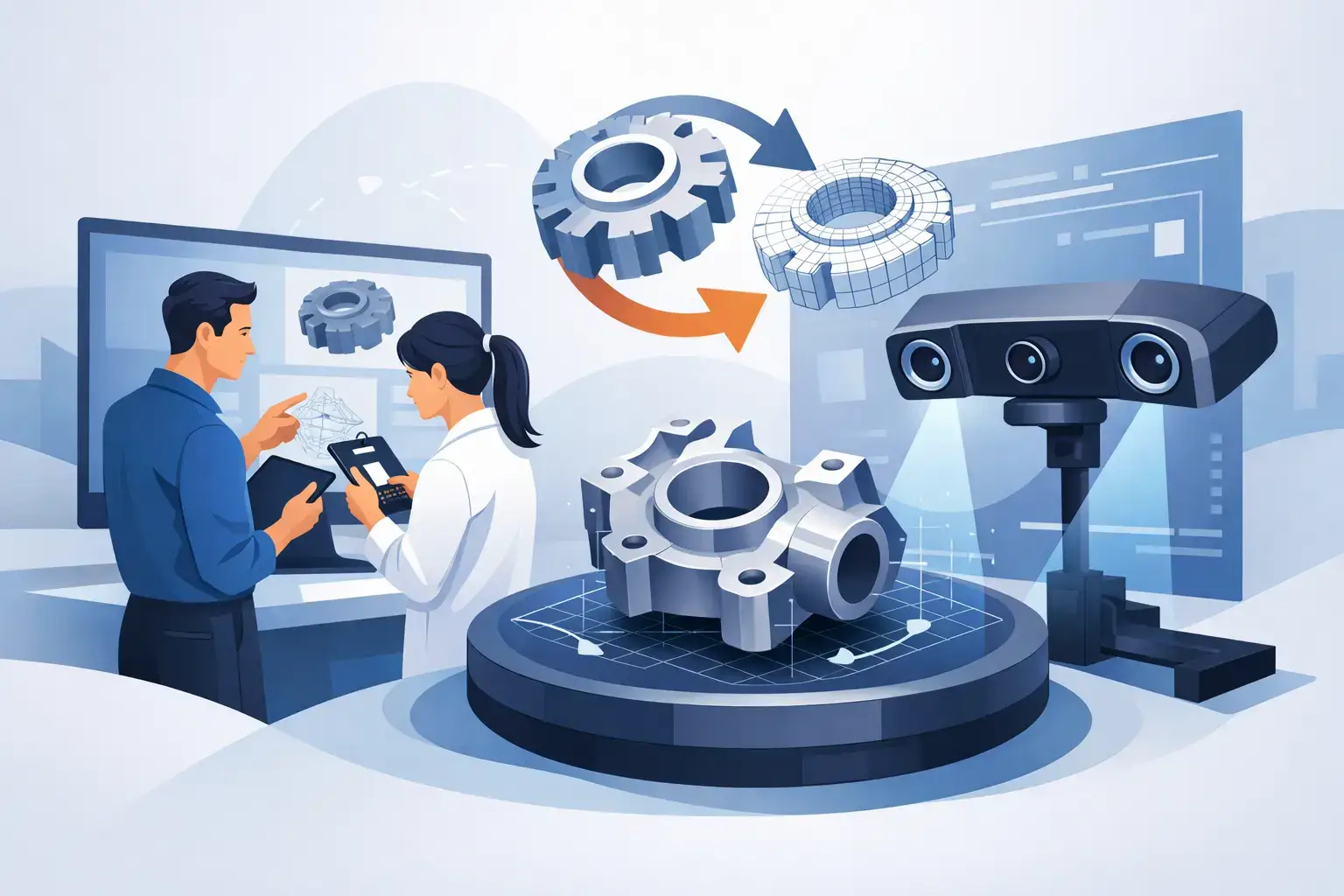
At a basic level, reverse engineering means extracting design intent from an existing object. That object might be a worn component, a hand-made form, an outdated part, or a one-off prototype. The process usually begins with 3D scanning or dimensional measurement, but the real work happens after capture.
The raw scan data often contains noise, missing areas, and details that do not directly translate into manufacturing logic. A production-ready reverse engineering workflow refines that data into usable CAD geometry, checks tolerances, identifies design constraints, and adapts the model for the next stage of fabrication.
In practice, reverse engineering services may include surface reconstruction, parametric CAD modeling, part cleanup, dimensional correction, design modification, material selection support, and prototype validation. If the end goal is manufacturing, the service should also account for process-specific requirements such as draft angles for molds, wall thickness for 3D printing, or machining access for CNC production.
Why businesses use reverse engineering services
Most projects do not start from a blank screen. They start from something that already exists, but not in a form that is easy to reproduce.
A manufacturer may need to replace a discontinued component without waiting for a supplier that no longer supports it. An event producer may want to replicate a physical prop in multiple sizes and materials. An architect may need to capture an existing ornamental feature and integrate it into a new build. A brand team may want to convert a hand-sculpted retail element into a repeatable production piece.
In each case, reverse engineering services reduce uncertainty. Instead of approximating dimensions or rebuilding by eye, teams can work from verified data. That improves fit, accelerates iteration, and limits expensive surprises later in the process.
The time savings can be substantial, but speed is only one part of the equation. Reverse engineering also protects visual fidelity. For sculptural, branded, or heritage-related work, preserving the character of the original object matters just as much as mechanical accuracy.
Reverse engineering is not just for industrial parts
Many buyers associate reverse engineering with machine components, and that is certainly one major use case. But the service is just as valuable in creative and commercial production.
Consider a public art piece that needs to be duplicated for another location. Or a retail display element originally sculpted by hand that now needs a mold for short-run casting. Or a custom housing for electronics that must fit around an existing internal assembly with very little tolerance for error. In all of these scenarios, reverse engineering becomes a bridge between physical form and scalable production.
That is where a multi-process studio has an advantage. When the same team can scan, model, prototype, machine, print, finish, and install, design decisions are made with fabrication in mind from the start. That usually leads to fewer revisions and more predictable outcomes.
What to look for in reverse engineering services
The first question is not what scanner a provider uses. It is whether they understand the final application.
If the goal is a visual replica for display, the modeling strategy may prioritize surface character and finish quality. If the goal is a functional replacement part, tolerance control, fit, and material performance take priority. If the object will be reworked for mass customization or mold production, the team needs to think beyond geometry and into manufacturability.
A strong provider should be able to explain how the captured data will be translated into the exact deliverable you need. That might be a watertight mesh, a clean solid model, a modified assembly, a 3D printed prototype, or a finished production part. These are not interchangeable outputs.
It also helps to ask how they handle damaged or incomplete originals. Many reverse engineering projects involve worn edges, broken sections, or asymmetrical distortion. A capable team can reconstruct missing geometry intelligently rather than simply copying flaws into the new model.
Where the process can get complicated
Reverse engineering sounds straightforward until the original object is more complicated than it appears.
Reflective surfaces can challenge optical scanning. Soft materials can deform during capture. Internal features may require more than external surface data. Old parts often vary from their intended design because of wear, heat, or manual modifications over time. In those cases, the question is not just what the object measures today, but what it was supposed to be.
This is why reverse engineering often includes interpretation. Engineers and fabrication specialists may need to compare symmetry, infer centerlines, rebuild key dimensions, and make judgment calls about which features should be preserved, corrected, or enhanced.
There is also a trade-off between speed and refinement. A quick scan-to-print workflow can be enough for some visual applications. For high-precision fitment or production tooling, more time spent on CAD cleanup and validation is worth it. The right level of effort depends on what happens next.
How reverse engineering connects to fabrication
The best reverse engineering services do not stop at digital reconstruction. They connect directly to fabrication.
Once the model is built, the object can move into rapid prototyping, CNC machining, mold making, resin casting, or industrial 3D printing depending on the use case. That continuity matters because each manufacturing method imposes different constraints. A model intended for fiberglass fabrication may need a different surface strategy than one being machined from aluminum. A part designed for laser cutting has a different logic than one built for additive manufacturing.
When reverse engineering is handled in the same production environment as prototyping and fabrication, those downstream requirements are identified early. That reduces rework and helps the digital model serve the real build, not just the file archive.
For clients managing tight deadlines or high-visibility projects, this integrated approach can be the difference between a concept that stalls and a deliverable that ships.
Who benefits most from an integrated partner
The biggest gains usually come on projects where technical complexity and visual expectations are equally high.
That includes architectural details, branded installations, custom displays, obsolete components, functional prototypes, vehicle parts, sculptural reproductions, and one-off products that may later need small-batch production. In these cases, coordinating separate scanning, CAD, prototyping, and finishing vendors adds friction fast.
A studio such as 3Distica can move from physical capture to engineered model to finished object under one roof. For clients across the UAE, Saudi Arabia, Qatar, and Oman, that model is especially useful when timelines are compressed and quality control cannot be left to handoffs between suppliers.
How to know if your project is a fit
If you already have perfect CAD, you probably do not need reverse engineering. But if your only starting point is a physical object, an outdated part, a handmade form, or a damaged component that still needs to be reproduced, modified, or scaled, reverse engineering services are often the cleanest route.
The strongest projects are the ones with a clear next step. You are not scanning for the sake of scanning. You are building toward a replacement part, a prototype, a mold, a product update, or an installation-ready fabrication package.
That is the real measure of value. Reverse engineering is not just about recreating what already exists. It is about giving existing objects a second life in a production workflow that is faster, smarter, and more precise.
If your project starts with a physical reference instead of a design file, that is not a setback. It may be the most useful place to begin.