
End to End Fabrication Workflow Explained
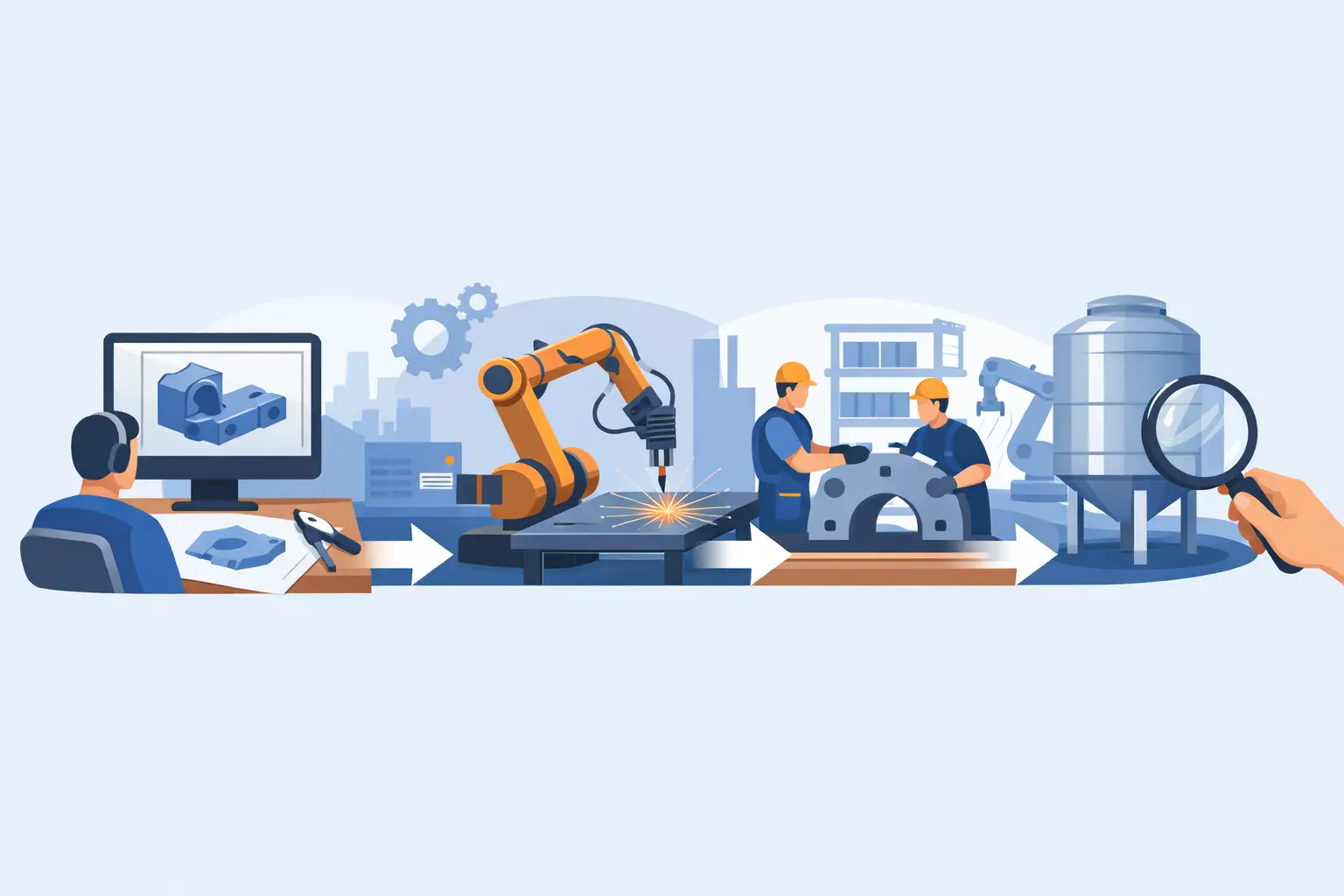
A fabrication project usually starts breaking down long before anything reaches the shop floor. The concept is approved, then files move to one vendor, prototyping goes somewhere else, finishing gets outsourced, and installation becomes its own scramble. An end to end fabrication workflow solves that problem by treating design, engineering, production, finishing, and delivery as one connected system instead of a relay race.
For architects, agencies, developers, and product teams, that shift matters more than it sounds. The difference is not just convenience. It affects lead time, cost control, visual consistency, manufacturability, and how many surprises appear when deadlines are already tight.
What an end to end fabrication workflow actually means
An end to end fabrication workflow is a single managed process that takes a project from idea to finished physical output. That can include concept development, 3D modeling, material selection, prototyping, fabrication, finishing, assembly, quality checks, logistics, and installation.
The key idea is continuity. Instead of handing the project off between disconnected specialists, each stage is informed by what came before and what needs to happen next. A design is developed with fabrication constraints in mind. A prototype is evaluated against finishing requirements. Production planning accounts for transport, site conditions, and final presentation.
That continuity is where most value sits. A beautiful rendering means very little if the geometry cannot be machined efficiently, the part cannot be cast cleanly, or the finished piece cannot be installed safely on site.
Why fragmented production creates avoidable risk
When projects are split across multiple vendors, every transition introduces friction. Files need to be reformatted. Tolerances get interpreted differently. Materials are substituted without full visibility. Timelines shift because one supplier is waiting on another.
This does not always lead to failure, but it does create weak points. On a branded environment, even a slight mismatch in finish can cheapen the final result. On an architectural model, dimensional drift can undermine stakeholder confidence. On a custom product or mechanical component, small errors can affect fit, performance, or repeatability.
There are trade-offs, of course. Specialized vendors can sometimes offer niche expertise or lower pricing on a single process. If you already have a highly disciplined internal production manager, coordinating separate suppliers may be workable. But for custom, multi-stage projects with tight visual and technical requirements, fragmentation often costs more than it saves.
The stages of an end to end fabrication workflow
1. Concept and design definition
The first stage is not just about aesthetics. It is where the project brief becomes buildable. Dimensions, performance goals, budget limits, brand requirements, site constraints, and timeline all need to be clear enough to guide decisions downstream.
This is also where experienced fabrication teams ask the right questions early. Should the form be optimized for CNC machining or additive manufacturing? Does the part need structural reinforcement? Will the finish hide layer lines, or does the surface need a different production route entirely? Early design intelligence prevents expensive revisions later.
2. Digital modeling and engineering
Once the concept is defined, 3D modeling and engineering turn intent into production data. Depending on the project, that may include CAD development, reverse engineering, tolerance planning, split lines for mold making, assembly design, or structural considerations.
This stage is often underestimated by buyers who are focused on the final object. But accurate digital preparation is what allows fabrication to move with confidence. A complex sculpture, a custom display unit, and a replacement component for a classic car all require different levels of engineering discipline, even if they share similar tools later in the process.
3. Prototype validation
Prototyping is where assumptions meet reality. Sometimes that means a rough form study to validate scale and presence. Sometimes it means a near-final sample to test surface quality, part fit, or user interaction.
Not every project needs multiple prototype rounds. A simple signage element may move quickly from file to production. A high-visibility installation or custom product usually benefits from more validation. The right prototype strategy depends on budget, complexity, and the cost of getting it wrong in final production.
4. Fabrication and manufacturing
This is where the workflow becomes materially real. The method could involve industrial 3D printing, CNC machining, laser cutting, fiberglass fabrication, resin casting, mold making, or a hybrid of several processes.
The best route depends on quantity, geometry, strength requirements, finish expectations, and delivery schedule. A one-off display piece may favor speed and visual impact. A functional part may prioritize dimensional accuracy and material performance. A repeatable branded element may need tooling that supports consistency across multiple units.
An integrated team can make these calls faster because it sees the whole picture. It is not selecting a process in isolation. It is selecting a process that supports the final result.
Why the finishing stage deserves more attention
Many buyers think fabrication ends when the part comes out of the machine, printer, or mold. In reality, that is often the halfway point. Surface finishing, paint, texture, polishing, graphics application, and assembly are what turn a manufactured object into a presentation-ready result.
This matters even more in public-facing work. Event installations, branded displays, awards, sculptures, and architectural features are judged at close range. Surface imperfections that seem minor in production can become highly visible under lighting, photography, or foot traffic.
Finishing also affects functionality. Protective coatings, edge treatment, adhesion prep, and part alignment all influence durability and performance. If finishing is treated as an afterthought, the project may look good for a day and degrade quickly after launch.
How an end to end fabrication workflow improves speed
Speed is not just about producing faster. It comes from reducing decision lag, file confusion, and rework. When design, prototyping, fabrication, and finishing are aligned from the start, the team spends less time resolving conflicts between stages.
That does not mean every integrated workflow is automatically faster. If the scope is poorly defined or approvals are delayed, a single partner cannot erase those issues. But integrated execution usually shortens the path between problem and solution. The person adjusting the CAD model is closer to the machine operator. The finishing team can flag a geometry issue before production scales. Installation planning starts before crates are packed.
For clients managing launches, events, fit-outs, or public deadlines, that compression of uncertainty is often more valuable than shaving a few hours off machine time.
Quality control gets stronger when the process stays connected
A connected workflow creates clearer accountability. If one team owns the project across stages, it is easier to maintain tolerances, finish standards, and design intent. There is less room for the classic vendor-to-vendor problem where each party claims the issue started somewhere else.
This is especially relevant on premium custom work, where quality is judged both technically and visually. A fabricated component may need precise fit, but it may also need a flawless painted finish, hidden fasteners, and clean assembly lines. Those requirements are easier to protect when they are managed under one production strategy.
Studios with broad in-house capability, such as 3Distica, are positioned well here because they can move between artistic fabrication and industrial precision without forcing clients to rebuild the team for each phase.
When this workflow makes the biggest difference
An end to end fabrication workflow is most valuable when a project crosses disciplines. That includes branded environments with structural and visual demands, architectural models with presentation pressure, one-off sculptures with complex surfaces, custom products moving toward launch, and replacement or specialty parts that need reverse engineering before manufacture.
It also matters when the finish is part of the deliverable, not just the object. A fabricated shell is one thing. A display-ready, client-ready, install-ready piece is another.
For projects across the UAE, Saudi Arabia, Qatar, and Oman, where logistics, timing, and site coordination can add another layer of complexity, having one production partner can remove a surprising amount of friction.
What to ask before choosing a fabrication partner
If you are evaluating providers, ask how the workflow is managed from concept through delivery. Not just what machines they own, but how files are reviewed, how prototypes are approved, how finish standards are controlled, and how changes are handled midstream.
A capable shop can produce parts. A capable end-to-end partner can protect outcomes. That difference becomes obvious when deadlines tighten, revisions happen, or the final piece needs to perform as well as it presents.
The smartest fabrication decisions usually happen before production starts. When design, engineering, making, and finishing are treated as one workflow, ambitious ideas have a much better chance of arriving exactly as intended.