
CNC Machining vs 3D Printing: Which Fits?
When a project has real deadlines, visible surfaces, and performance requirements, the choice between CNC machining vs 3D printing is not academic. It affects lead time, part strength, finish quality, unit cost, and how many production problems show up later. For architects, product teams, agencies, and manufacturers, the right process is usually the one that gets the part approved faster and performs exactly as intended once it is in hand.
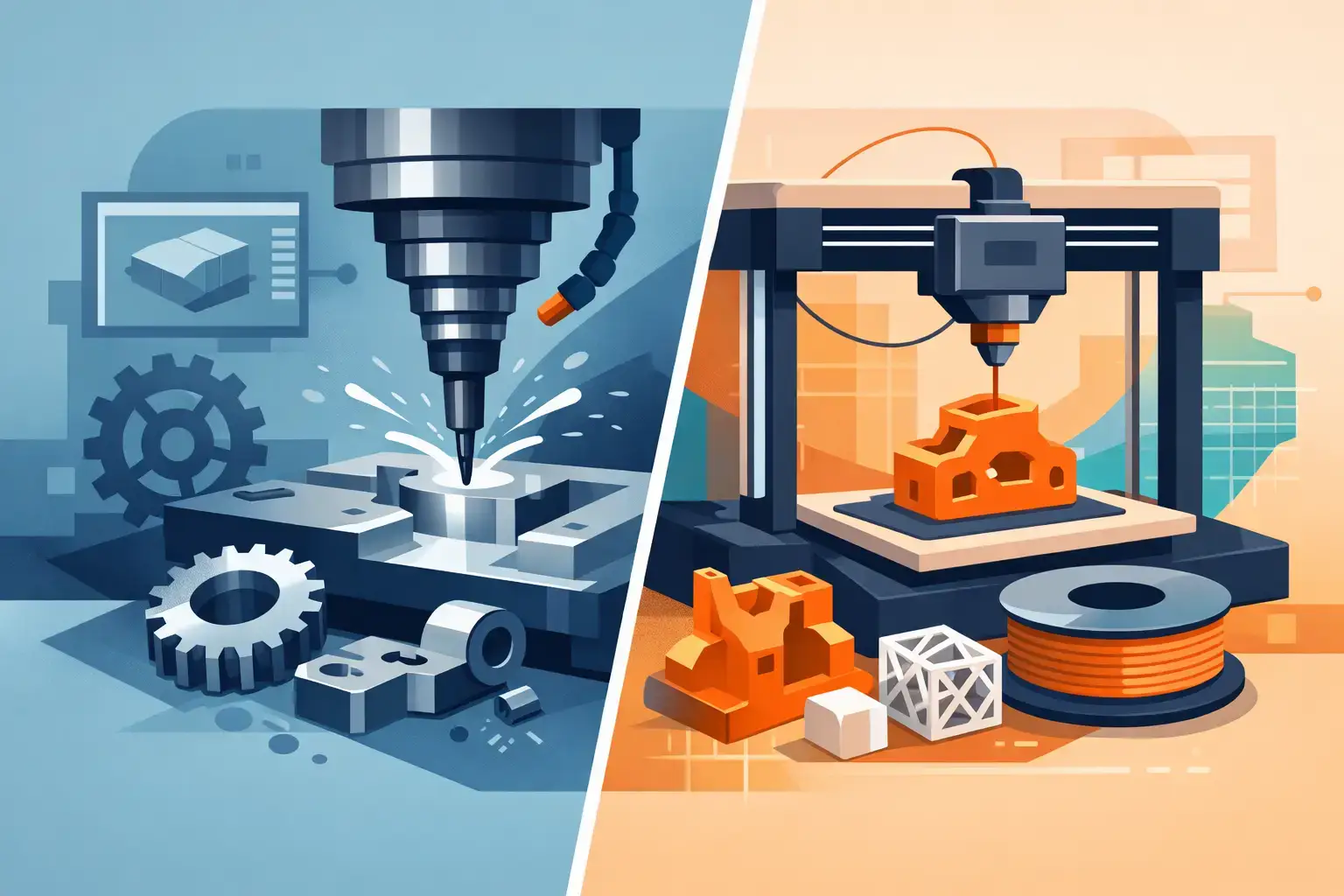
That is why this comparison matters. Both methods are powerful, but they solve different problems. One removes material with precision. The other builds geometry layer by layer. On paper, that sounds simple. In production, the trade-offs are more nuanced.
CNC machining vs 3D printing: the core difference
CNC machining is a subtractive process. A machine starts with a solid block or sheet of material and cuts away everything that is not part of the final form. This approach is ideal when tolerances matter, surfaces must look clean, and the material itself needs to deliver structural performance.
3D printing is additive. The part is built in layers from plastic, resin, powder, or other printable media. That changes what is possible geometrically. Internal channels, complex curves, lightweight structures, and one-off forms become easier to produce without custom tooling.
For many clients, the real question is not which technology is better overall. It is which one is better for this stage of the project. A concept model, a presentation piece, a fit-check prototype, a mechanical component, and a customer-facing final part may all call for different methods.
Where CNC machining wins
CNC machining has a clear advantage when precision and material integrity are non-negotiable. If a part needs to be made from aluminum, stainless steel, engineering plastic, MDF, acrylic, or another production-grade substrate with predictable behavior, machining is often the most dependable route.
This matters in functional components. Mounting plates, housings, brackets, jigs, fixtures, mechanical interfaces, and parts that mate with existing assemblies benefit from CNC because tolerances are tighter and material performance is known. If a part must be drilled, tapped, assembled, fastened, or repeatedly handled, CNC usually reduces risk.
Surface quality is another major reason teams choose it. A machined acrylic panel, aluminum part, or precision-cut element can come off the machine looking clean and professional, especially when finishing steps are planned properly. For branded environments, architectural details, retail fixtures, and custom display components, that visual consistency can be just as important as dimensional accuracy.
There is also scale to consider. If the part is larger, flatter, or panel-based, CNC can be more practical than printing. Full-size signage elements, structural mockups, routed forms, and production components often make more sense as machined parts than oversized prints that require segmentation and assembly.
The trade-off is geometry. CNC tools need physical access to the area being cut. Deep internal cavities, organic undercuts, and highly intricate enclosed forms are harder or impossible to machine efficiently. The design may need to be split into multiple parts or adjusted for tool access.
Where 3D printing wins
3D printing changes the conversation when speed of iteration is the priority. If a team needs to test form, validate fit, review scale, or present a design before committing to a final production method, printing is often the fastest path from file to object.
It also excels in complexity. Shapes that would be expensive or impractical to machine can be printed with relatively little penalty. Organic surfaces, lattice structures, internal voids, sculptural details, and one-off customizations are where additive manufacturing becomes especially valuable.
That is why 3D printing is so effective for concept models, architectural maquettes, custom enclosures, presentation prototypes, figurative pieces, artistic work, and parts that need frequent revision. If version three is different from version two, you update the file and print again. There is no need to rethink fixturing or tooling in the same way.
For low-volume custom work, printing can also be cost-efficient. A single unit with unusual geometry may be cheaper to print than to machine, especially if the machined version would require multiple setups or extensive hand finishing.
Still, printing has limits. Surface texture often needs post-processing. Dimensional consistency can vary based on print method and orientation. Mechanical properties are not always equal in every direction. And while some printed materials are highly capable, many are chosen for speed and form validation rather than long-term structural use.
Cost is rarely as simple as it looks
One of the biggest misconceptions in CNC machining vs 3D printing is that 3D printing is always cheaper. For early prototypes, that can be true. For highly complex one-off parts, it can also be true. But once you factor in material choice, post-processing, tolerances, finishing, and part size, the economics shift.
A small printed prototype may cost less than a machined one. A large printed part that needs sanding, filling, priming, assembly, and paint may not. Likewise, a simple machined part from sheet stock can be produced very efficiently, especially when repeatability matters.
The right way to evaluate cost is to ask what you are actually buying. Is this a proof of concept, a camera-ready display piece, a mechanical part, a mold pattern, or an end-use component? The cheapest manufacturing quote is not the lowest project cost if the result creates delays, revisions, or quality issues downstream.
Finish, strength, and real-world performance
If a part will be seen, touched, installed, or used under load, finish and function need to be considered together.
Machined parts generally start from stronger, more uniform material stock. That gives them an advantage for structural applications and parts with strict mechanical demands. Threads hold better, edges can be controlled more precisely, and flatness is easier to maintain.
Printed parts can absolutely be production-worthy, but the process and material have to match the job. A resin display model, an FDM prototype, and an industrial nylon part are not interchangeable. Each has a different balance of resolution, durability, and cost. This is where technical guidance matters, because a process that works beautifully for a presentation model may fail in a mechanical application.
Appearance is similar. A printed part can achieve excellent visual quality, but usually through post-processing. Sanding, filling, coating, painting, and finishing make a major difference. CNC parts can also require finishing, of course, but the starting surface is often cleaner and more consistent for many commercial applications.
The smartest answer is often both
For complex builds, the strongest production strategy is not choosing one process and forcing it to do everything. It is using each method where it adds the most value.
A product housing might be 3D printed for early design reviews, then CNC machined once the geometry is locked and the part needs better strength or tighter tolerances. A sculptural installation may use printed forms for intricate details and CNC-cut internal supports for stability. A branded activation could combine machined acrylic, printed custom features, laser-cut elements, and finished surfaces into one coordinated deliverable.
This hybrid approach saves time because it aligns the process with the project phase. It also improves quality. Instead of compromising the design to fit one machine, the production plan fits the actual demands of the object.
That is especially relevant for teams managing ambitious commercial and creative work across the UAE, Saudi Arabia, Qatar, and Oman, where timelines are compressed and the final result has to look resolved, not experimental.
How to choose the right process for your project
Start with the part’s job, not the technology. If the part must perform mechanically, hold tight tolerances, or present a refined material finish, CNC is often the safer choice. If the goal is speed, iteration, design validation, or producing a complex custom form without tooling, 3D printing may be the better move.
Then consider what happens next. Will the part be reviewed internally, shown to stakeholders, installed on site, or replicated later? Will it be painted, plated, assembled, or used as a master for molding? These downstream decisions often matter more than the first manufacturing step.
The most efficient projects come from looking at the full production path. That is where an integrated fabrication partner becomes valuable. When design, prototyping, machining, printing, finishing, and assembly are aligned from the start, decisions get sharper and handoff errors disappear. At 3Distica, that integrated view is often what turns a difficult brief into a buildable outcome.
The better question is not CNC machining vs 3D printing in the abstract. It is what your part needs to do, how fast it needs to get there, and what level of quality it has to carry once it arrives. Start there, and the right process usually becomes clear.