

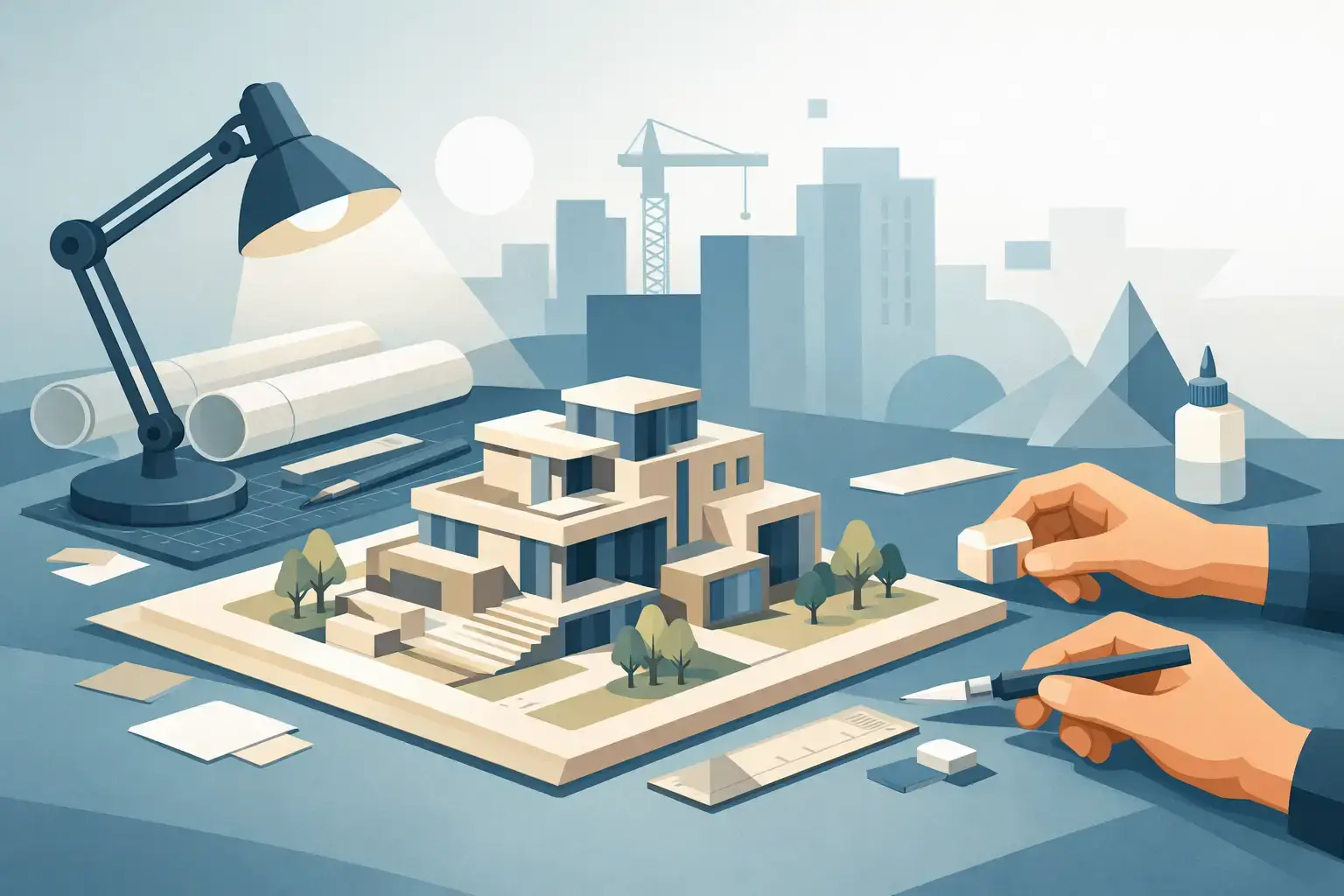
Architectural Model Production Guide
When a model arrives late, chips at the corners, or fails to communicate the design in the first five seconds, the problem usually started much earlier than fabrication. A strong architectural model production guide is not just about making a beautiful object. It is about controlling decisions from scope and scale to material behavior, lighting, transport, and final presentation so the model performs exactly as it should.
For architects, developers, real estate teams, and exhibition planners, that performance matters. Some models are sales tools. Some are planning tools. Some need to survive weeks on display under harsh lighting and constant handling. Others need gallery-level finish quality for a launch, jury review, or VIP presentation. The right production approach depends on where the model will be seen, who will use it, and what story it needs to tell.
What this architectural model production guide should solve
The biggest misconception is that all architectural models serve the same purpose. They do not. A concept massing model, a leasing office centerpiece, a competition model, and a museum-grade urban context model all require different levels of precision, finish, and durability.
That changes everything upstream. If the model is meant for design development, speed and editability may matter more than cosmetic perfection. If it is for investor presentations, edge quality, surface consistency, lighting integration, and brand alignment become part of the brief. If it will travel between cities or appear in a public installation, structural reinforcement and packing design are just as important as the facade details.
Production starts with that clarification. Before anyone chooses acrylic, resin, MDF, or 3D printed components, the team needs to define the model’s job. That single step prevents expensive revisions later.
Scope first, then scale
Scale is often treated as a visual decision, but in production it is really a systems decision. A 1:500 urban model can communicate massing and context clearly, but it will not carry intricate facade depth or interior detail. A 1:100 model may show materiality, glazing rhythm, and landscape features well, but it quickly grows in footprint, weight, and transport complexity.
The right scale depends on the information the viewer needs to absorb at a glance. If the goal is urban relationship and site impact, smaller scales are efficient. If the purpose is to sell a premium development or explain design intelligence, a larger scale often earns its footprint because it creates visual confidence.
Scope has to be locked to scale. Teams often request full site context, interior sections, removable roofs, lighting, and landscaping in a model size that cannot physically support all of that without becoming visually crowded. That is where discipline matters. A focused model communicates more effectively than one trying to show every idea at once.
Deciding what belongs in the model
Not every element deserves equal emphasis. Roads, podiums, planting, neighboring buildings, water features, signage, and people can all help tell the story, but only if they support the main objective.
A useful question is simple: what must the client understand immediately? If the answer is facade articulation, then the surrounding context should stay quiet. If the answer is site planning, the landscape and circulation need more attention. When everything is highlighted, nothing is clear.
Material choice shapes the result
Material selection is where visual intent meets manufacturing reality. Clean white acrylic can create a precise, contemporary presentation language. MDF and engineered boards can work well for base structures and layered topography. Resin casting is effective when repeated components need consistency. CNC machining helps where repeatability and crisp geometry matter. Industrial 3D printing is often the best route for complex forms, curved envelopes, and custom elements that would be slow to machine by hand.
No single process is best for every project. That is why integrated production matters. A high-end model often combines multiple methods in one build – CNC-cut base layers, 3D printed building masses, laser-cut facade details, cast resin duplicates, and hand-finished surface treatments.
Trade-offs are real here. A material that looks perfect under studio lighting may scratch too easily in a sales gallery. A delicate printed component may capture the geometry beautifully but fail under repeated transport. A low-cost board may keep the budget under control but absorb paint inconsistently at the finishing stage. Good production teams evaluate the full lifecycle, not just the fabrication step.
Digital preparation is where accuracy is won or lost
Most production delays come from file issues, not machine time. Architectural design files are rarely ready for direct fabrication without cleanup. Geometry may be too detailed in some areas and too vague in others. Wall thicknesses may not translate at the chosen scale. Floating surfaces, open meshes, duplicated elements, and missing tolerances create downstream problems.
A fabrication-ready file set needs rationalization. That means simplifying what will not read at scale, thickening fragile features, separating parts logically for assembly, and planning joins before manufacturing begins. If lighting is included, cable paths and access points need to be designed into the model rather than improvised afterward.
This is one reason an end-to-end production partner can save both time and quality. The handoff between modeling, prototyping, fabrication, finishing, and installation becomes shorter and more controlled because the team is solving for the final object from the start, not just producing parts.
Architectural model production guide for finish quality
People notice finish quality before they can articulate why a model feels premium. Surface consistency, alignment, clean adhesive work, sharp corners, even paint coverage, and controlled material contrast all signal precision. Poor finishing does the opposite. It makes even strong design work feel unresolved.
The challenge is that finishing standards should match the model’s use case. A rough conceptual model can be intentionally minimal. A launch model for a developer or a public-facing display cannot. It needs disciplined assembly, stable bases, protected edges, and a finish that holds up under close viewing.
Lighting adds another layer. Integrated illumination can transform a model, especially for hospitality, mixed-use, and residential presentations. But it needs restraint. Overlit models can feel theatrical in the wrong way and may distract from the architecture. The best lighting supports hierarchy – key program areas, circulation, and focal features – without becoming the entire story.
Color, texture, and realism
Not every project benefits from photorealistic treatment. Sometimes a monochrome palette communicates more authority because it keeps attention on form and planning. In other cases, especially for sales environments and branded presentations, strategic color and texture help audiences read material transitions, amenity zones, or brand cues faster.
The decision should be intentional. Hyper-detailed landscaping, glossy finishes, and simulated water effects can be impressive, but they can also age quickly if they are not executed at a very high level. A restrained model with excellent craftsmanship often has more lasting impact than a highly embellished one with inconsistent detailing.
Production timelines are built around risk, not optimism
Many model schedules fail because the quoted lead time only covers fabrication, not decision-making. Real production includes design review, file cleanup, sample approvals, prototype checks, material sourcing, finishing, assembly, quality control, packing, and sometimes installation on site.
The more complex the model, the more the timeline should reflect checkpoints. That is not bureaucracy. It is risk management. A quick prototype of one tower facade or one landscape zone can prevent major rework later. Likewise, confirming base dimensions and transport constraints early avoids the common problem of a finished model that is difficult to move through doors, elevators, or event venues.
For projects in the UAE, Saudi Arabia, Qatar, and Oman, timing often tightens around launches, exhibitions, and real estate milestones. That makes production planning even more valuable. Fast turnaround is possible, but only when the workflow is organized around manufacturing realities rather than presentation deadlines alone.
Presentation, transport, and installation are part of production
A model is not done when fabrication ends. It still has to arrive, install cleanly, and hold its quality in the final environment. That means the base, cover, crate, and installation method all deserve design attention.
Acrylic covers protect models well, but they change viewing angles and can introduce reflections under venue lighting. Open-display formats feel more immediate, but they increase risk of dust, touching, and edge damage. Modular construction may be necessary for access and transport, but part lines and assembly tolerances must be carefully managed so the final piece reads as one object.
This is where full-service production becomes practical, not just convenient. When one team can handle fabrication, finishing, packing, and installation, quality control extends all the way to the moment the model is on display. That continuity is often what separates a technically made object from a fully resolved presentation piece.
If you are planning a model that needs to persuade, endure, and represent the design with confidence, treat production as part of the architecture itself. The best models do more than shrink a building. They make decisions visible.