

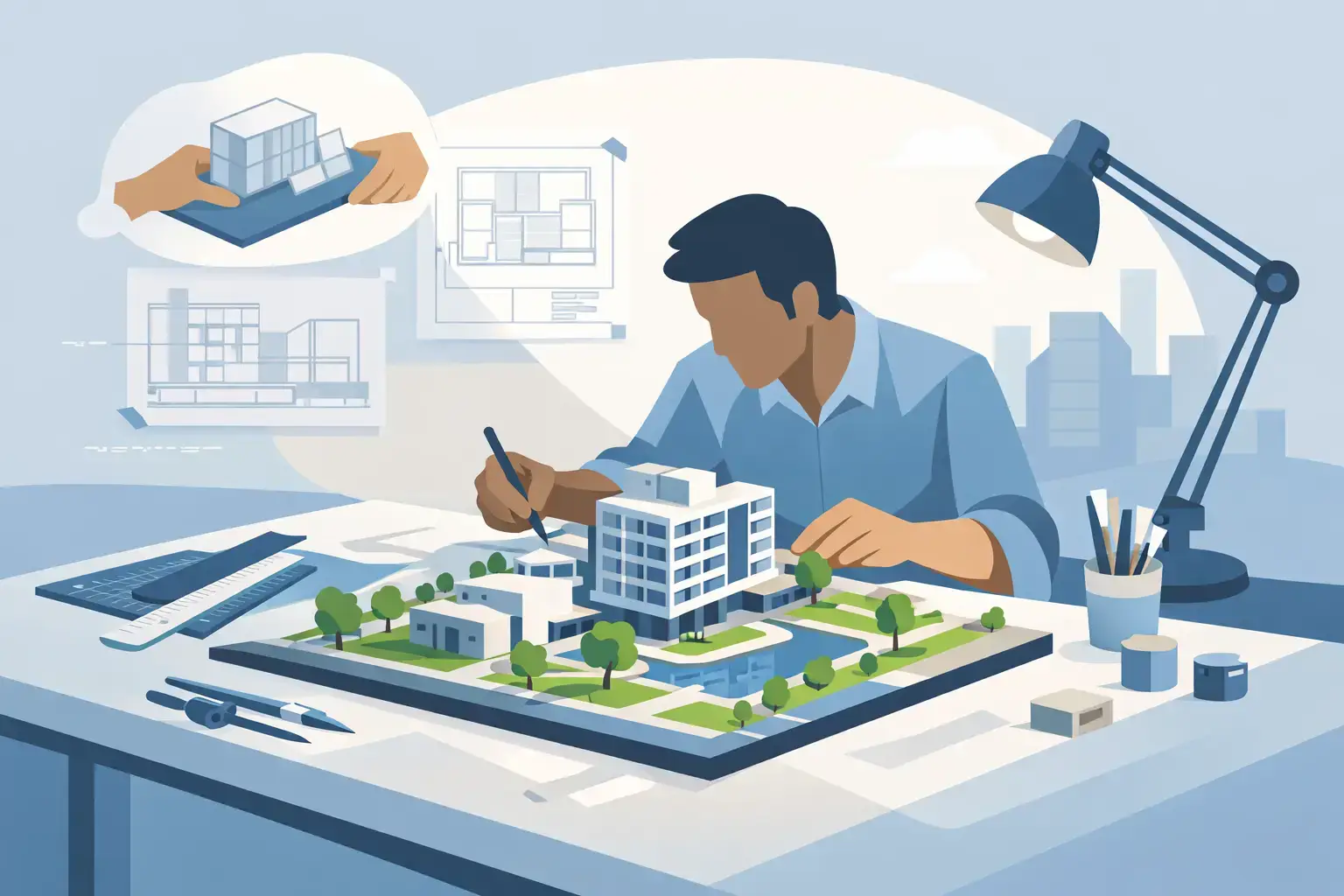
What Great Architectural Model Makers Do
A render can look flawless on screen and still fall flat the moment stakeholders try to understand scale, massing, or material impact in the real world. That gap is exactly where architectural model makers prove their value.
For architects, developers, and design teams working under deadline, a physical model does more than present an idea. It clarifies proportion, exposes design conflicts, supports approvals, and gives clients something they can read instantly. In high-stakes projects, that clarity is not a nice extra. It is part of the decision-making process.
Why architectural model makers still matter
Digital visualization has become sharper, faster, and more immersive. You can walk clients through a project in real time, layer in lighting studies, and produce polished flythroughs that look ready for a campaign launch. Yet physical models continue to hold a distinct advantage because they compress complexity into a format people understand at a glance.
A well-made model communicates hierarchy, circulation, context, and scale without requiring a headset, a screen, or a presentation script. In design reviews, people gather around a model differently than they gather around a rendering. They point. They compare. They ask better questions. That changes the quality of feedback.
This is especially true when multiple audiences are involved. Planners, investors, leasing teams, sales teams, and non-technical stakeholders rarely interpret drawings or digital environments in the same way. A physical model gives them a shared reference point. It reduces ambiguity, and ambiguity is expensive.
What architectural model makers actually contribute
The best model makers are not just fabricators producing miniature buildings. They translate design intent into a physical object that needs to be accurate, durable, legible, and visually controlled all at once.
That translation takes judgment. Not every detail in a BIM file belongs in a physical model. Some elements need to be simplified so the massing reads clearly. Others need to be emphasized because they carry the architectural story. A facade pattern that works at full scale may disappear at model scale unless it is reinterpreted through material, engraving, or layered fabrication.
This is where experience matters. Skilled model makers understand scale behavior, tolerances, assembly logic, material finish, lighting integration, and presentation requirements. They know when to push for a cleaner abstraction and when the project demands high-fidelity detail. They are solving communication problems, not just manufacturing parts.
The difference between a display piece and a working model
Not every model serves the same purpose, and this is where many projects go off track. A competition model, a planning submission model, a sales suite centerpiece, and an investor presentation model may all represent the same building, but they should not be approached the same way.
A working design model often prioritizes speed and flexibility. Teams may need removable sections, interchangeable massing blocks, or fast revisions as the design evolves. The finish can be restrained if the goal is internal decision-making.
A presentation model is different. It needs stronger visual hierarchy, cleaner surface treatment, and more polished assembly. Lighting, landscaping, branding, acrylic covers, plinths, and transport requirements all become part of the scope. At that stage, the model is doing commercial work as well as design work.
The trade-off is straightforward. The more refined and presentation-ready a model becomes, the more planning it requires. Fast changes become harder once finishing, lighting, and final detailing are underway. That is why the best outcomes usually come from aligning the model strategy with the project stage from the start.
Materials, methods, and why in-house capability changes the result
Architectural model making looks precise from the outside because precision is what clients see. Behind that finish is a chain of production decisions that affects quality, speed, and consistency.
CNC machining can deliver clean structural forms and repeatable components. Laser cutting is ideal for crisp layers, facade panels, and site plan elements. Industrial 3D printing helps when geometry becomes more complex or highly customized. Hand finishing remains essential because machine accuracy alone does not create presentation quality.
Then there are the supporting processes people often underestimate. Surface preparation, paint matching, resin casting, assembly sequencing, protective packaging, and installation all influence the final outcome. If these steps are split across multiple vendors, small errors compound quickly. Tolerances drift. Finishes vary. Timelines slip.
That is why integrated production matters. When design translation, fabrication, finishing, and final presentation happen under one roof, quality control improves and decision-making gets faster. A team that can move from 3D modeling into prototyping, machining, printing, finishing, and installation without handoff friction has a practical advantage, not just a marketing one.
How architects and developers should evaluate architectural model makers
Choosing a model making partner should go beyond reviewing photos of polished finished pieces. Appearance matters, but execution depth matters more.
First, assess whether the team understands the purpose of the model. If they start by asking about audience, use case, scale, transport, and revision expectations, that is a strong sign. Good model makers do not treat every brief as a generic fabrication request.
Second, look at production range. A studio with only one manufacturing method may try to force every project into the same workflow. A stronger partner can combine methods based on geometry, budget, and timeline. That flexibility often leads to cleaner results and fewer compromises.
Third, ask about finishing standards. Architectural models are judged harshly at close range. Glue marks, warping, rough edges, inconsistent paint, and uneven lighting will be noticed immediately. Technical capability means little if surface quality is weak.
Finally, consider project management. Complex models need disciplined file handling, approval gates, revision control, and delivery planning. A visually impressive workshop is not enough. You need a team that can execute under commercial pressure.
Where the process usually succeeds or fails
Most model projects do not fail because the idea is too ambitious. They fail because the brief arrives too late, the source files are not organized, or the production timeline ignores finishing and transport realities.
The strongest process begins with a clear objective. What decisions should the model help people make? What needs to stand out immediately? Is the context critical, or is the focus entirely on the building? Does the model need to travel, survive repeated handling, or sit permanently in a sales environment?
From there, file readiness becomes a major factor. Clean geometry, coordinated layers, clear material intent, and defined scale save time and reduce fabrication risk. If the design is still in flux, that is not a problem by itself, but the fabrication strategy should reflect it. Building a highly finished model from unstable source information is usually a costly choice.
A good production partner will also flag what is likely to cause problems before fabrication begins. This might include wall thicknesses that do not translate well at scale, facade details that will visually clog, or unrealistic expectations around turnaround. Honest pre-production feedback is part of the value.
Why this matters in fast-moving regional markets
In markets like the United Arab Emirates, Saudi Arabia, Qatar, and Oman, design presentation is often tied directly to investor confidence, public visibility, and accelerated delivery programs. Models are frequently used in developer pitches, exhibitions, approvals, and premium sales environments where first impressions carry financial weight.
That raises the standard. The model cannot simply be accurate. It needs to be presentation-ready, transportable, durable, and aligned with the project brand. Teams operating in these environments often benefit from working with a fabrication partner that can manage not just model production, but also prototyping, finishing, display components, branded environments, and installation. That broader capability reduces coordination risk when the schedule is tight and expectations are high.
For clients looking for that kind of integrated execution, 3Distica brings the advantage of in-house design translation, advanced fabrication, surface finishing, and final delivery through a single production workflow.
The real value is confidence
At their best, architectural models reduce hesitation. They help design teams present with more authority, help clients make decisions faster, and help projects move forward with fewer misunderstandings.
That does not mean every project needs a large-scale showpiece. Sometimes a simpler model is the smarter choice. But when the goal is to communicate design intent with precision and impact, the right model can do something screens still struggle to replicate – it makes the project feel real before it is built.
If you are commissioning one, the smartest move is to treat the model not as an accessory at the end of the process, but as a strategic production asset that deserves the same rigor as the design itself.