
When CNC Machining Makes Prototype Sense
A prototype that looks right but fails the moment it meets real hardware is expensive in all the wrong ways. That is usually the moment teams stop asking for a quick model and start asking for a part that behaves like the final product. This is where cnc machining for prototypes earns its place.
For engineers, product teams, architects, and fabrication buyers, CNC is not the default answer to every prototype. It is the right answer when geometry, tolerances, surface quality, and material behavior actually matter. If the goal is to validate fit, function, fastening, load paths, or a customer-facing finish, machining often gets you closer to production reality than additive methods alone.
What cnc machining for prototypes is really good at
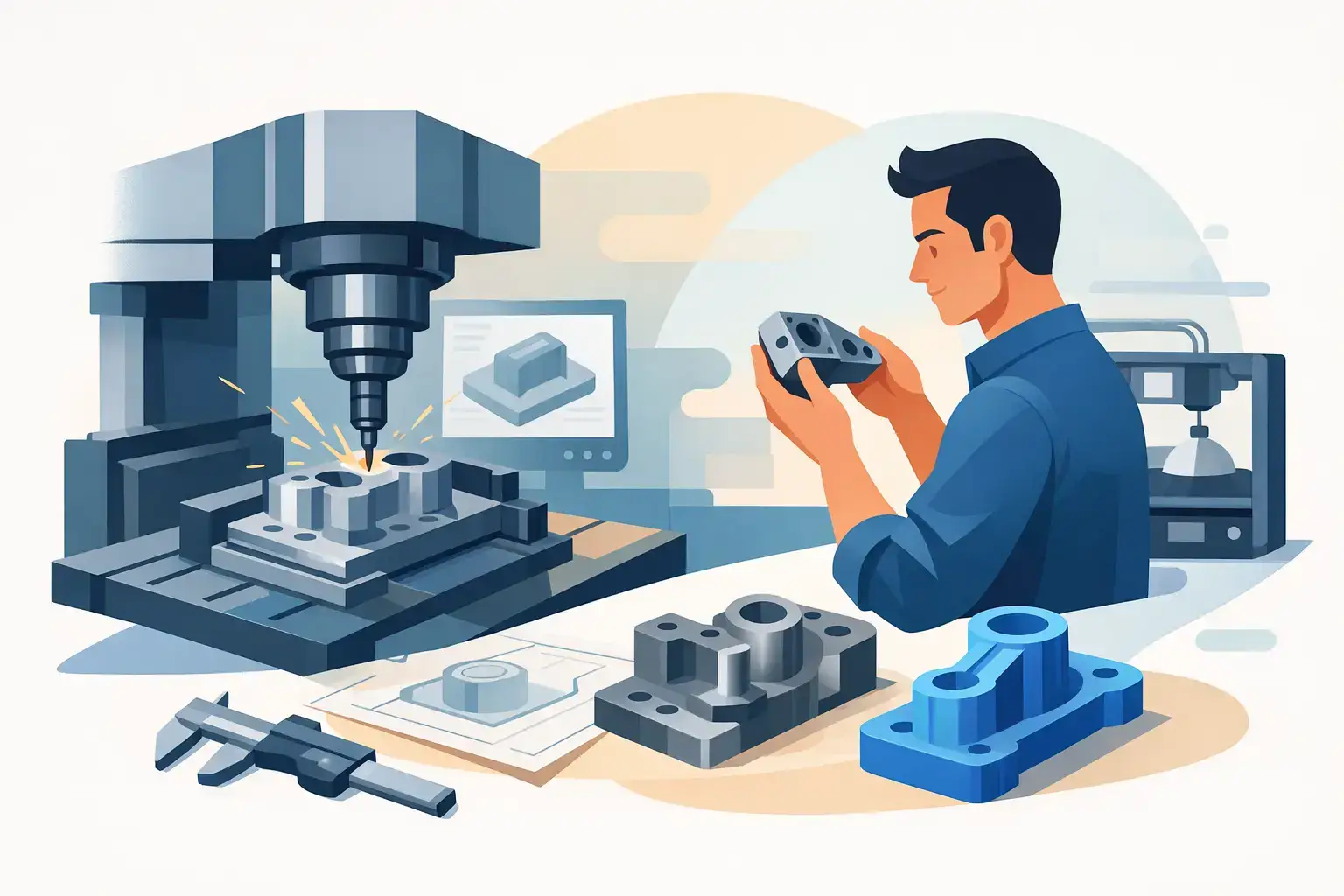
CNC machining creates parts by cutting away material from a solid block using controlled tools and programmed toolpaths. That sounds straightforward, but the real advantage is not simply accuracy. It is material truth.
A machined aluminum enclosure will behave like aluminum. A machined acetal gear will tell you more about wear and engagement than a printed approximation. A machined polycarbonate lens housing will reveal assembly issues that a cosmetic mockup can easily hide. When prototype decisions depend on stiffness, thermal performance, thread quality, or dimensional stability, CNC gives clearer answers.
That matters across a wide range of projects. A consumer product startup may need functional housings before tooling. An architecture team may need precision components for a kinetic display. A brand activation fabricator may need a one-off mechanical assembly that has to survive installation, transport, and public interaction. In each case, the prototype is not just a shape. It is a test of performance.
When cnc machining for prototypes is the better choice
The simplest way to frame it is this: choose CNC when the prototype needs to tell the truth.
If you need fine tolerances, CNC is usually the safer route. Press fits, bearing seats, gasket surfaces, and mating features all benefit from machining. If you need production-grade plastics or metals, CNC is often faster than waiting for tooling and more reliable than trying to simulate the same behavior with another process. If the part will be shown to stakeholders, investors, or end users, CNC can also deliver a more convincing finish straight off the machine or with post-processing.
That said, it depends on the stage of development. Very early concept exploration may still be better served by foam models, simple prints, or low-cost visual mockups. There is no prize for machining a part too early if the design is still moving. Good prototyping is not about choosing the most advanced process. It is about choosing the process that answers the next question with the least waste.
The trade-offs you should expect
CNC is powerful, but it is not magic. It has trade-offs, and serious teams plan around them.
The first is cost. Machined prototypes typically cost more than basic 3D printed parts, especially for complex geometry, multi-sided setups, or tight tolerances. The second is design constraint. Internal corners have tool radii, undercuts require special tooling, and deep narrow pockets can become expensive quickly. The third is lead time variability. A simple bracket may move fast. A multi-material assembly with finishing and tight inspection can take longer than expected.
None of those are reasons to avoid CNC. They are reasons to design intelligently. When teams understand the process early, they make better decisions about where precision matters and where it does not. That is where an integrated fabrication partner becomes valuable, because the prototype can be shaped around both design intent and manufacturing reality.
Designing a prototype for CNC without overengineering it
One of the most common mistakes in prototype development is treating every dimension as critical. It rarely is.
If you want speed and sensible cost, identify the surfaces and features that actually drive performance. Those may be alignment bores, mounting faces, sealing edges, or visual surfaces. Hold tighter tolerances there, and relax the rest. This reduces machining time, inspection complexity, and unnecessary revisions.
Wall thickness matters too. Extremely thin walls can chatter, deform, or force slower cutting strategies. Deep pockets and tall unsupported features can create similar problems. If internal corners do not need to be sharp, let them carry a practical radius. If cosmetic appearance matters, call that out early because finish strategy changes how the part should be machined.
Material choice is another place where prototype goals can drift. If you are testing structure, pick the production-intent material or the closest practical equivalent. If you are testing appearance only, there may be more flexible options. If you are testing both, be honest about which one matters more. Trying to optimize everything in one prototype can lead to a part that is expensive without being especially useful.
Materials make the prototype meaningful
The strongest case for CNC often comes down to material selection.
Aluminum is a frequent choice because it machines well, offers good dimensional stability, and gives a strong read on production viability for housings, brackets, fixtures, and visible components. Stainless steel is useful when corrosion resistance or strength is part of the test, though it adds machining time and cost. Brass is excellent for fittings, decorative details, and smooth-machining precision parts.
On the plastic side, acetal works well for low-friction parts and mechanical components. ABS and nylon can support functional testing depending on the application. Polycarbonate is helpful when toughness matters. Acrylic can look clean and polished, but it is not always the best stand-in for impact-heavy use.
The point is not to chase a perfect material on the first pass. It is to make sure the prototype behaves closely enough to reveal what the design still needs.
CNC and 3D printing work better together than apart
The smartest prototype programs rarely choose only one process.
A printed concept model can validate form, scale, or stakeholder feedback in a day. Then CNC can take over when the project reaches functional testing, presentation-ready detailing, or production-aligned verification. In some builds, hybrid prototyping is the best route: print the complex noncritical form, machine the interfaces, and finish the assembly as one cohesive piece.
That kind of workflow is especially effective for custom commercial and display-driven projects, where appearance and mechanical performance often need to coexist. A studio that can handle modeling, prototype strategy, machining, finishing, and fabrication in one pipeline can cut out a lot of handoff friction. That is one reason clients working on high-visibility builds in the UAE, Saudi Arabia, Qatar, and Oman often prefer a partner with both design fluency and manufacturing depth.
How to get better results from a CNC prototype request
A good RFQ is not just a file upload. It is a decision package.
Send the 3D model, of course, but also identify the purpose of the prototype. Is it for fit check, functional testing, customer approval, or pre-production validation? Note the material preference, quantity, finish expectations, and any truly critical dimensions. If a face has to look presentation-ready, say so. If a threaded hole will only be used once during testing, that matters too.
This context changes how the part should be made. Without it, a supplier may quote the geometry correctly but miss the intent. The strongest prototype outcomes happen when machining strategy follows project goals, not just CAD data.
At 3Distica, that is often where the real value starts – translating an idea into a prototype that is not just manufacturable, but useful.
The question behind every prototype
The real question is not whether CNC is precise. It is whether precision helps you make the next decision faster.
If your project needs a prototype that assembles properly, survives handling, reflects final materials, or looks ready for the room it is being pitched in, CNC is often the right move. If the design is still too fluid, another method may buy you more learning for less money. The best teams know the difference.
A strong prototype should remove uncertainty, not just create a nice object. When you choose cnc machining for prototypes at the right moment, you stop guessing and start building with evidence.